📝 Prerequisites: Can solve standard 3x3 cube
🎯 Goal: Solve by shape instead of color
What Makes Mirror Cube Unique?
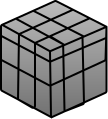
The Mirror Cube (also called Mirror Blocks or Bump Cube) is a shape-shifting puzzle. All pieces are the same color (usually silver/gold), so you solve by shape and size instead of colors!
Key Differences
- Pieces have different sizes
- Single color (all silver/gold)
- Changes shape when scrambled
- Must use shape recognition
What You'll Learn
- Shape recognition
- Size differentiation
- 3D spatial reasoning
- Same algorithms as 3x3!
Understanding Piece Sizes
The key to solving the Mirror Cube is recognizing pieces by their size and shape:
Center Pieces
- Largest center: Opposite of smallest center
- Medium centers: Four centers of equal height
- Smallest center: Opposite of largest center
Centers never move relative to each other, just like on a 3x3!
Edge Pieces
- Tall edges: Between largest and smallest centers (4 pieces)
- Short edges: Between medium centers (8 pieces)
Edge height tells you where it belongs!
Corner Pieces
- Largest corner: Between largest, and two medium centers
- Smallest corner: Between smallest and two medium centers
- Medium corners: Between three medium centers (6 total)
Corner size indicates its position in the solved cube!
Solution Strategy
Use the exact same method as solving a 3x3 cube! The only difference is recognition:
Step 1: Choose Your "Color" Scheme
SetupDecide which size represents which "color" on a standard cube:
Recommended Mapping:
- White = Smallest center (solve this face first)
- Yellow = Largest center (opposite face)
- Medium centers = Red, Orange, Blue, Green
Step 2: Solve the First Layer
Same as 3x3Make a cross and solve first layer corners using your standard 3x3 method.
Recognition Tips:
- Tallest edges go in the cross (between small and large centers)
- Smallest corner goes between small and two medium centers
- Match edge/corner heights to center heights
- Look at piece dimensions from multiple angles
Step 3: Solve Second Layer
Same AlgorithmsInsert second layer edges using standard 3x3 algorithms.
Standard Edge Insertion:
Right insert:
Left insert:
Step 4: Last Layer Cross
Shape RecognitionOrient the top layer edges using standard OLL algorithms.
Cross Algorithms:
Line to Cross:
L-Shape to Cross:
Steps 5-7: Complete Last Layer
Standard 3x3Finish solving using your normal last layer method:
- Position edges: Use edge permutation algorithms
- Position corners: Use corner permutation algorithms
- Orient corners: Use corner orientation algorithms
All algorithms from 3x3 tutorial work identically!
Recognition Mastery
The hardest part is identifying pieces. Here are strategies to improve:
🔍 Visual Scanning
Rotate the cube constantly. Look at pieces from different angles to see their full dimensions.
📏 Relative Sizing
Compare pieces directly. Hold two pieces next to each other to determine which is taller/wider.
🎯 Focus on Edges First
Edges are easier to identify (only tall vs short). Build confidence with edges before tackling corners.
🧩 Practice Slow
Take 10-15 minutes on your first solves. Speed comes with pattern recognition, not rushing.
Common Challenges
Challenge #1: Misidentifying Pieces
Solution: Compare pieces side-by-side. When in doubt, try inserting the piece - if it doesn't fit the shape, try another piece.
Challenge #2: Losing Track of Orientation
Solution: Mark the smallest center with a sticker or remember its position. This is your reference point.
Challenge #3: Cube Won't Turn Smoothly
Solution: Mirror cubes need good alignment. Make sure layers are properly aligned before turning.
Practice Tips
- Start simple: Do only 5-10 moves to scramble initially
- Lighting matters: Good lighting helps distinguish subtle size differences
- Compare with 3x3: Keep a solved 3x3 nearby as reference
- Photo reference: Take a photo of solved state for reference
- Be patient: First solve may take 30+ minutes - that's normal!
Advanced Variations
Ghost Cube
Even more extreme shape-shifting
ExpertFisher Cube
Rotated 3x3 with different cuts
IntermediateAxis Cube
Centers rotate, shape changes
IntermediateMaster the Mirror Cube! ✨
You now have all the knowledge needed. The Mirror Cube rewards patience and careful observation!