📝 Prerequisites: Basic twisty puzzle experience helpful
🎯 Goal: Solve Skewb consistently in under 1 minute
What is the Skewb?
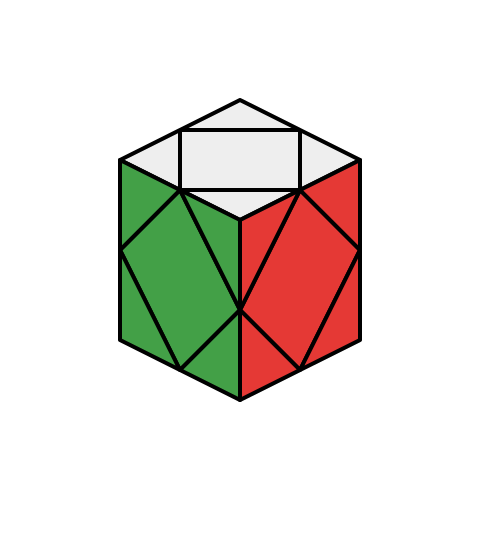
The Skewb is a corner-turning cube that looks similar to a Rubik's Cube but turns completely differently! Instead of turning faces, you turn corners at 120-degree angles.
Unique Features
- Corners turn, not faces
- 120° rotation angles
- Only 4 axes of rotation
- Very different from Rubik's Cube
Puzzle Pieces
- 8 corner pieces (3 colors each)
- 6 center pieces (fixed positions)
- No edge pieces!
- ~100 million combinations
Understanding Skewb Movement
When you turn a corner, 7 pieces move (the corner itself plus 6 adjacent pieces). This creates interesting scramble patterns!
Skewb Notation
We'll use simple notation for the 4 corners you can turn while holding the cube normally:
- R = Right corner clockwise
- L = Left corner clockwise
- B = Back corner clockwise
- F = Front corner clockwise (rarely used)
- ' = Prime (counterclockwise)
Each turn is 120 degrees, so three turns brings you back to start!
Beginner Method (Sarah's Advanced Method)
We'll use a popular beginner method that's also used by speedcubers:
Step 1: Solve Four Centers
IntuitiveMake four centers on four sides (not all six). Leave top and bottom for later.
Strategy:
- Pick a center color (e.g., white)
- Solve four centers around the middle "belt" of the cube
- This step is completely intuitive - just play around!
- Don't worry about corners or the remaining two centers yet
Recognition:
When done correctly, you should have 4 centers solved in a "belt" around the middle of the cube.
Step 2: Solve All 8 Corners
2 AlgorithmsPosition and orient all corner pieces using just two simple algorithms.
Algorithm 1: Sledgehammer
Used to swap and orient corners on top layer.
Algorithm 2: Hedgeslammer
Used for more complex corner manipulations.
How to Use:
- Hold cube with 4 solved centers around the middle
- Focus on top and bottom faces (unsolved)
- Use algorithms to position corners correctly
- May need to apply algorithms multiple times
- Rotate top/bottom and try different setups
Step 3: Solve Remaining Centers
1 AlgorithmFinally, orient the last two centers (top and bottom) to solve the cube!
Center Swap Algorithm:
Alternative (shorter):
When to Use:
- All corners are solved
- Only 2 centers need to be swapped or rotated
- Apply algorithm to cycle the last centers into place
Complete Solution Summary
1️⃣ Solve 4 centers (belt around middle)
Intuitive - no algorithms
2️⃣ Solve all 8 corners
Use Sledgehammer and Hedgeslammer algorithms
3️⃣ Solve remaining 2 centers
One final algorithm swaps/rotates centers
Alternative Method: Layer by Layer
Some prefer solving the Skewb layer by layer like a Rubik's Cube:
Layer by Layer Steps
- Solve one face completely (center + 4 corners)
- Solve opposite face
- Fix remaining centers
- Orient final corners
This method uses more algorithms but may feel more familiar to 3x3 solvers.
Common Patterns
Two Centers Swapped
Use center swap algorithm once
One Corner Twisted
Use Sledgehammer or setup moves
Corner Cycle
Three corners need to rotate positions
Almost Solved
Just centers wrong - one algorithm away!
Advanced Techniques
🚀 Sarah's Advanced Method (Speedsolving)
The same method as beginner, but with:
- Better recognition of corner cases
- Optimized fingertricks
- Planning first layer during inspection
- Sub-10 second solves possible!
Practice Tips
- Turn style: Skewb turns are unique - use your whole hand
- Algorithm practice: The same 2-3 algorithms solve most cases
- Pattern recognition: Learn to spot which corners need to move
- Track times: Use our timer
- Goal times: Sub-30 seconds is good, sub-10 is advanced
- Scrambling: Do at least 10-12 random turns to scramble properly
Common Mistakes
- ❌ Trying to solve all 6 centers first (harder!)
- ❌ Using 3x3 algorithms (they don't work)
- ❌ Not understanding what the algorithms do
- ❌ Giving up too early - Skewb has a learning curve!
Fun Facts
- 🎯 Invented by Tony Durham in 1982
- ⚡ World record is under 1 second!
- 🔄 Every position can be solved in 11 moves or less
- 🧩 The center pieces never move - they define the color scheme
- 🎲 God's number for Skewb is 11 (shortest solution always exists)
Related Puzzles
Master Skewb
Larger version with more pieces
AdvancedSkewb Diamond
Octahedron shape, same mechanism
IntermediateIvy Cube
Simplified Skewb (easier)
BeginnerMaster the Skewb! 🎲
The Skewb is deceptively simple but incredibly satisfying. With just 2-3 algorithms, you can solve it every time!