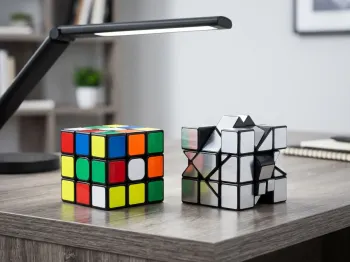
7 Stunning Mirror Cube Patterns That Will Look Amazing on Your Shelf
Transform your Mirror Cube into art! Discover 7 stunning patterns like the Superflip and Cube-in-a-C...

The world of speedcubing is a place where human potential is pushed to its absolute limits. What started as a casual puzzle has become a high-stakes competitive sport where every millisecond counts. Let's dive into the mind-bending world of Rubik's Cube speed records and explore just how fast humans can solve this iconic puzzle.
In the early 1980s, a sub-30-second solve was considered world-class. Today, top cubers consistently solve the cube in under 5 seconds. This incredible leap is due to several factors:
The official governing body for speedcubing is the World Cube Association (WCA). Here are some of the most astonishing records:
The current world record for a single 3x3x3 solve is an almost unbelievable 3.13 seconds, set by Max Park in 2023. This solve was so fast that it's hard to follow even in slow-motion replays.
While a single solve can be lucky, the average of 5 (removing the fastest and slowest times) shows true consistency. The world record is held by Yiheng Wang with a stunning average of 4.48 seconds.
For years, humans held the edge. But machine learning has changed the game. In 2018, a robot built at MIT solved a Rubik's Cube in just 0.38 seconds. While robots are faster, they rely on custom hardware and perfect information, making the human achievement arguably more impressive.
The world of competitive cubing extends far beyond the classic puzzle. Here are some other mind-boggling records:
A sub-4-second solve is a blur of motion, but it follows a precise structure:
Top cubers can perform over 10 turns per second.
The quest for the fastest Rubik's Cube solve is a testament to human dedication, innovation, and the power of practice. While robots may hold the ultimate speed title, the achievements of human cubers continue to inspire and astound. The sub-3-second human solve is no longer a question of 'if', but 'when'.