7 Stunning Mirror Cube Patterns That Will Look Amazing on Your Shelf
Transform your Mirror Cube into art! Discover 7 stunning patterns like the Superflip and Cube-in-a-C...
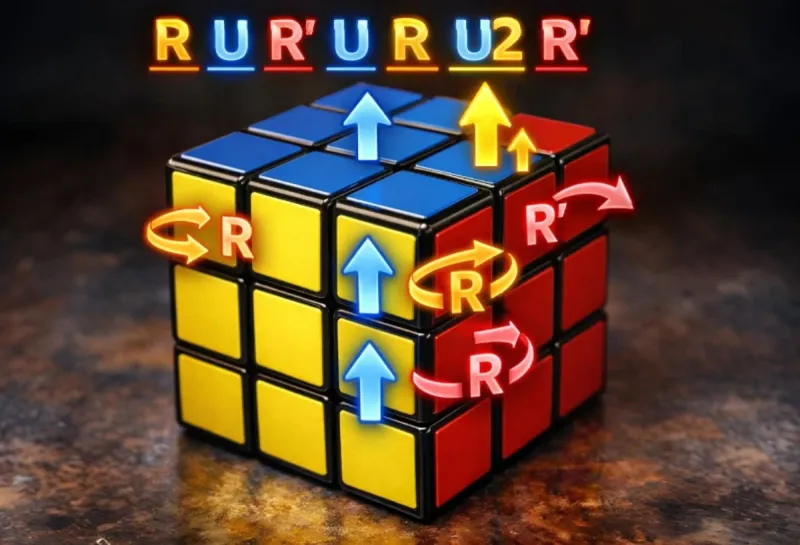
If you've ever looked up a tutorial on how to solve a Rubik's Cube, you were likely met with a string of cryptic letters like R U R' U'. This isn't secret code—it’s the universal language of speedcubing known as Singmaster Notation. Mastering this notation is the first step toward learning faster algorithms and improving your solve times.
In standard 3x3 notation, each of the six faces is represented by a single letter. When you see a letter, it means you should turn that face 90 degrees clockwise as if you were looking directly at that face.
Not every turn is clockwise. To indicate different directions or distances, we add symbols to the letters:
If a letter is followed by an apostrophe (e.g., R'), it is called "Prime." This means you turn that face 90 degrees counter-clockwise. For example, U' means you turn the top layer to the left.
If a letter is followed by the number 2 (e.g., F2), it means you turn that face 180 degrees (two turns). It doesn’t matter if you turn it clockwise or counter-clockwise, as the result is the same.
As you progress to advanced methods like CFOP or Roux, you will encounter more complex notation:
These involve moving the middle layers of the cube:
Sometimes you need to move the entire cube to change your perspective. These are written in lowercase:
The best way to learn notation is through muscle memory. Take a solved cube and perform a simple algorithm like the 'Sune' (R U R' U R U2 R') repeatedly. Eventually, your fingers will recognize the movements without you having to translate the letters in your head. Happy cubing!