7 Stunning Mirror Cube Patterns That Will Look Amazing on Your Shelf
Transform your Mirror Cube into art! Discover 7 stunning patterns like the Superflip and Cube-in-a-C...
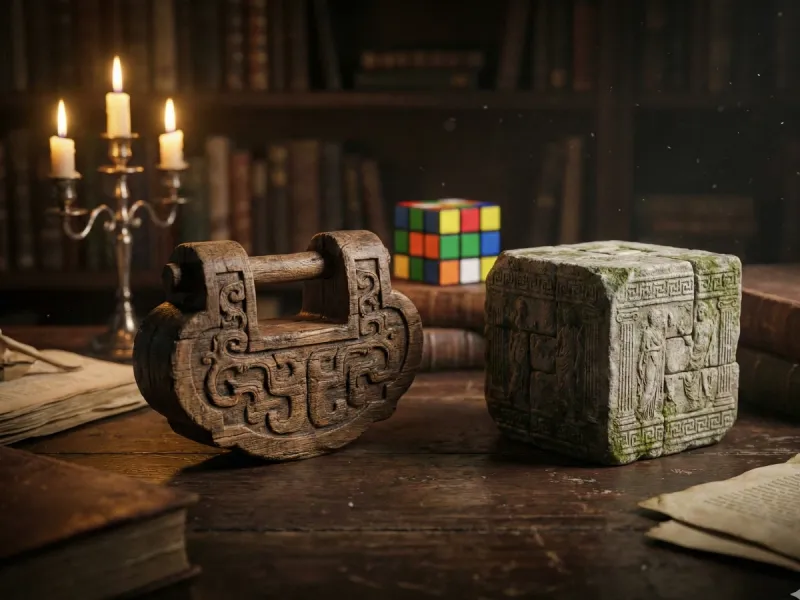
When Erno Rubik created his famous Magic Cube in 1974, he wasn't just inventing a toy; he was tapping into a thousands-year-old human obsession with spatial reasoning, interlocking mechanisms, and the triumph of logic over chaos. While the Rubik's Cube is a modern marvel of engineering, its spiritual ancestors can be found in the dusty scrolls of ancient Greece, the woodworking shops of dynastic China, and the epic tales of world mythologies.
Long before we were timing our cross-and-f2l sequences, the great mathematician Archimedes was obsessed with the Ostomachion (also known as the Loculus Archimedius). This puzzle consisted of 14 ivory pieces of varying shapes that formed a square. Much like a 3D puzzle, the goal was to rearrange them into different figures or back into the square. Recent studies suggest Archimedes used it to calculate the number of ways a geometric shape could be assembled—a direct precursor to the combinatorial mathematics we use to calculate the 43 quintillion permutations of a Rubik's Cube.
In the realm of historical legend, the Gordian Knot stands as the ultimate "unsolvable" puzzle. Mentioned in accounts of Alexander the Great, this intricate knot was tied so tightly and complexly that its ends were hidden inside. It represents the ancient world's fascination with topological complexity. While Alexander famously "solved" it by cutting it with a sword, speedcubers today follow a more disciplined path, untangling the "knot" of a scrambled cube through precise algorithms rather than brute force.
Perhaps the closest physical ancestor to the Rubik's Cube is the Lu Ban Lock (also known as the Kongming Lock). Attributed to the legendary Chinese carpenter Lu Ban from the Spring and Autumn period (770–476 BC), these are three-dimensional interlocking puzzles made of wood. Using only joinery and no glue or nails, these puzzles require the solver to move pieces in a specific sequence to disassemble and reassemble them. The spatial awareness required for a Lu Ban lock is remarkably similar to the logic needed to understand how a cube's core and pieces interact.
The concept of the "puzzle" as a test of wisdom appears frequently in the Bible and other ancient epics. Consider Samson’s Riddle in the Book of Judges, or the Queen of Sheba’s tests for King Solomon. While these weren't mechanical toys, they established the cultural value of the problem-solver. In the Mahabharata, the Pandava prince Yudhishthira had to answer the complex riddles of the Yaksha to save his brothers. These narratives reinforce the idea that solving a complex, seemingly impossible problem is a sign of high character and intellect—a sentiment every cuber feels after their first successful solve.
In the Edo period, Japanese artisans developed Kumiki puzzles. These are interlocking wood puzzles that often take the shape of animals, buildings, or spheres. Like the Rubik's Cube, they are tactile and require the solver to visualize parts of the object that are currently hidden from view. The evolution of these puzzles highlights a transition from architectural joinery to entertainment, mirroring the Rubik's Cube's journey from an architectural model to a global phenomenon.
Whether it’s a Greek mathematician with ivory tiles or a modern teenager with a magnetic speedcube, the drive remains the same: to bring order to a state of disorder. By looking at these historical and mythological puzzles, we see that the Rubik’s Cube isn't just a 1970s fad—it is the modern iteration of a timeless human quest for logic, symmetry, and the satisfaction of a puzzle solved.